This guide breaks down 7 coaching landing pages built in Perspective, each with its real conversion rate, from 5.8% to 41.0%. The pages that converted best ask one easy question or give away something free before they ask for contact details. Perspective builds pages like these as mobile-first funnels from a description of the offer and follows up with each lead within 60 seconds.
Example | First step | Rate |
Agency training | Free masterclass seat | 7.8% |
Executive coaching | 10-question scorecard quiz | 24.4% |
Running coaching | Goal question with 3 answers | 15.6% |
Youth football | Yes or no question for parents | 10.8% |
Coach training | Free workbook download | 41.0% |
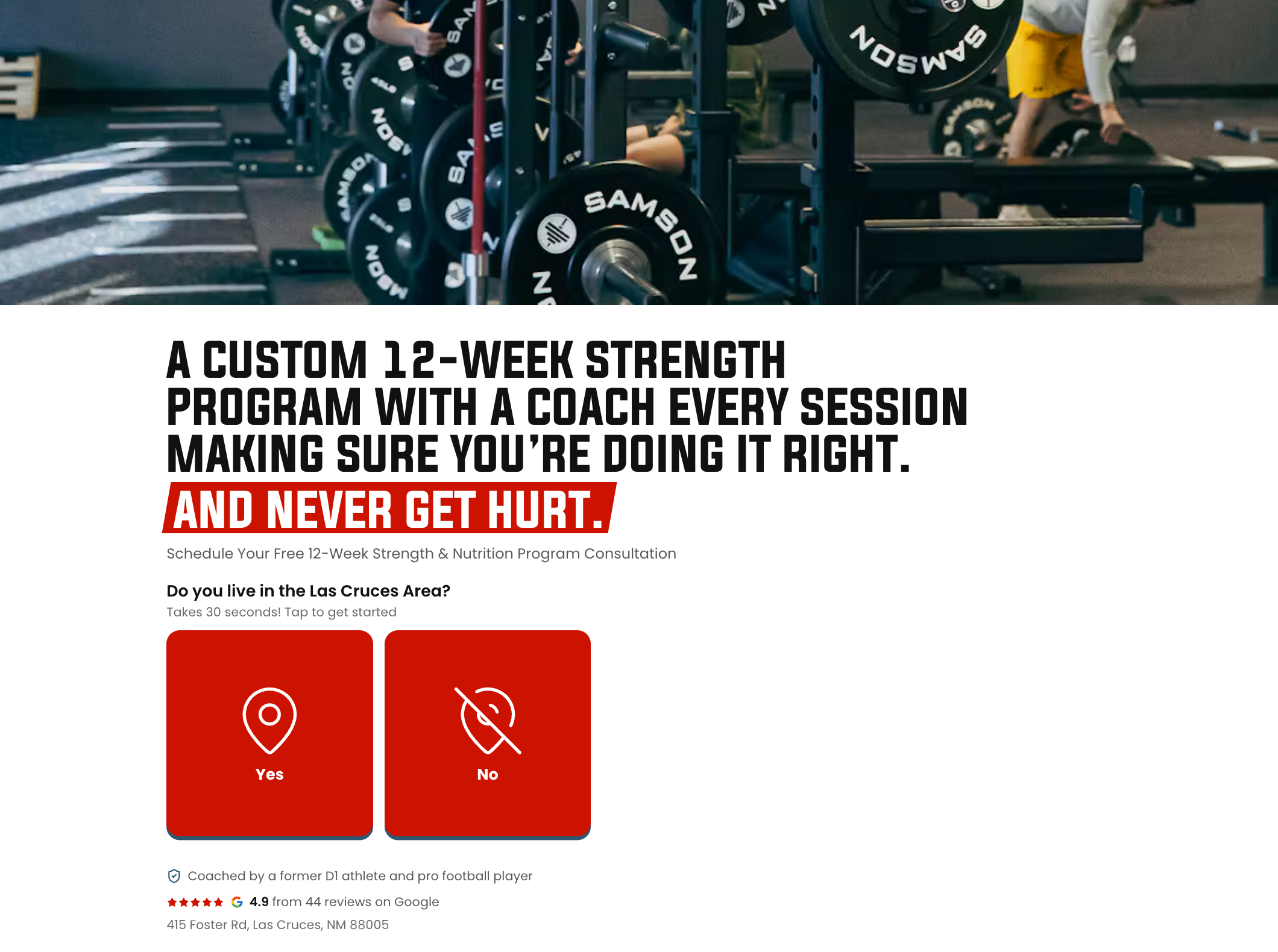
Strength coaching | Location question | 5.8% |
Tennis coaching | Pre-registration after prices | 6.4% |
Most coaches pay for the click and lose the visitor on the first screen. The ad worked. The page did not.
The coaching landing page examples below share one trait, and it is not a slick design. It is what they ask the visitor to do first.
Each one is a live page with its real conversion rate. Let's dive in.
What makes a coaching landing page high converting
A coaching landing page is a single page built to turn visitors into leads for one coaching offer, usually from paid traffic.
Coaching asks a lot of people. Signing up means committing to change something, whether it's their golf swing, their fitness or their career. That makes the first step harder to take than downloading a guide or buying a product.
So a coaching landing page has two jobs at once. Getting into the funnel has to feel easy, or visitors leave before they start. And it has to qualify them along the way, so the right people see the program is built for them.
These seven coaching landing page examples show how pages handle both.
7 coaching landing page examples: dissected
Here are 7 coaching landing page examples, from executive coaching to youth football. Every page was built in Perspective and runs on real paid traffic.
Click any image to open the live page.
1. Agency training

Conversion rate
7.8%
Why it converts
This is one of the strongest webinar-style coaching pages in the set. It works because it builds trust in the speaker first. The video sits above the headline, so visitors meet a real person first and decide whether they like them.
Under the headline, a live counter shows how many people have registered against the 100 live seats. Free webinars are easy to put off until later, but seeing seats fill up tells visitors that later might be too late.
What to steal
- Lead with the speaker on video. Let visitors see and hear the person before they read the pitch.
- Show seats, not just a date. A live counter of registrations against available seats makes a free session feel worth claiming now.
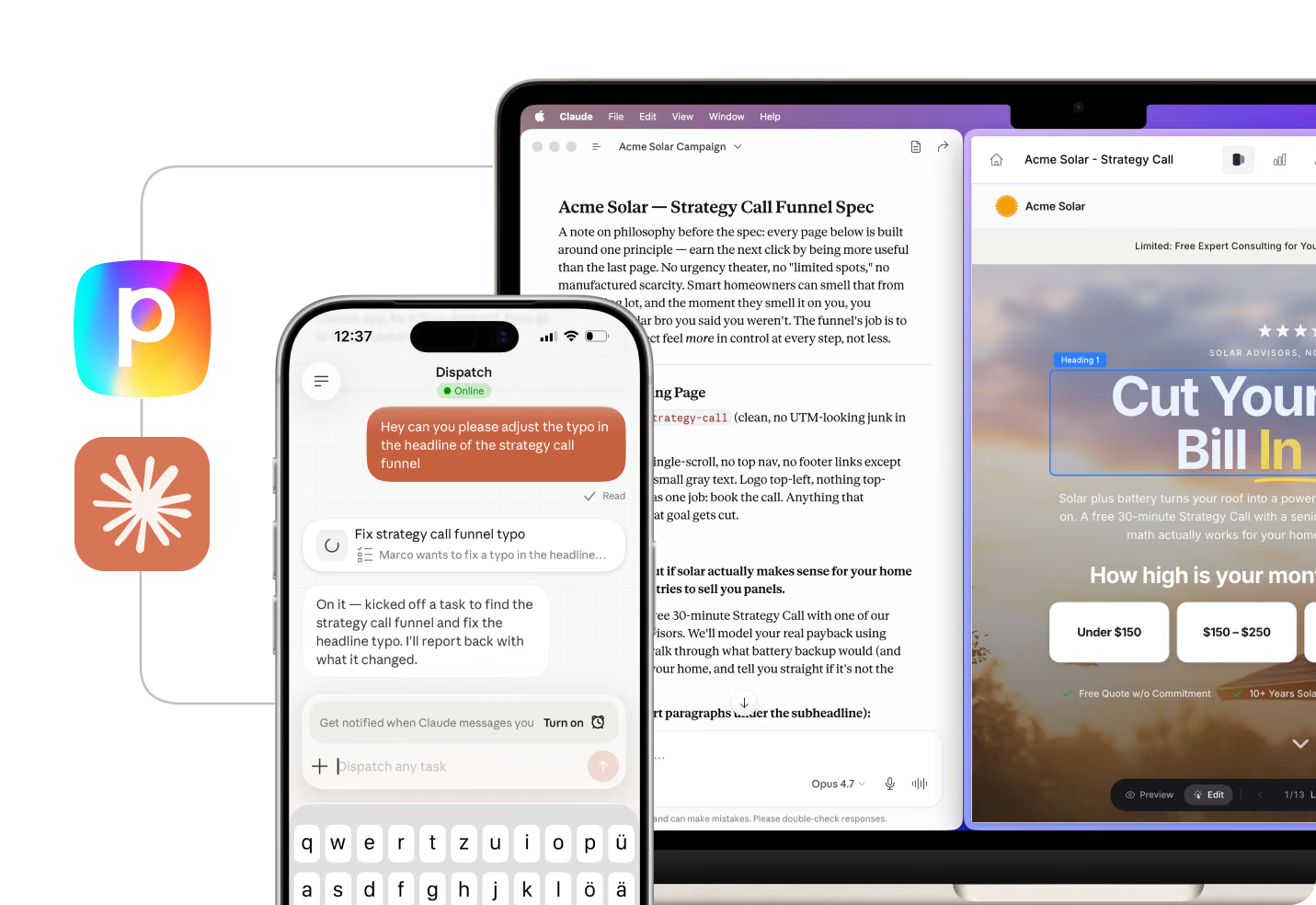
Perspective builds the whole funnel from a description of the offer. You can rebuild the same structure for a coaching webinar in minutes with the AI builder or the Perspective MCP, right in Claude.
Want a masterclass funnel like this for your own coaching offer? Describe the session, and Perspective launches it with hosting, tracking and follow-up connected. Then change any headline or section by hand.
2. Executive coaching
Conversion rate
24.4%
Why it converts
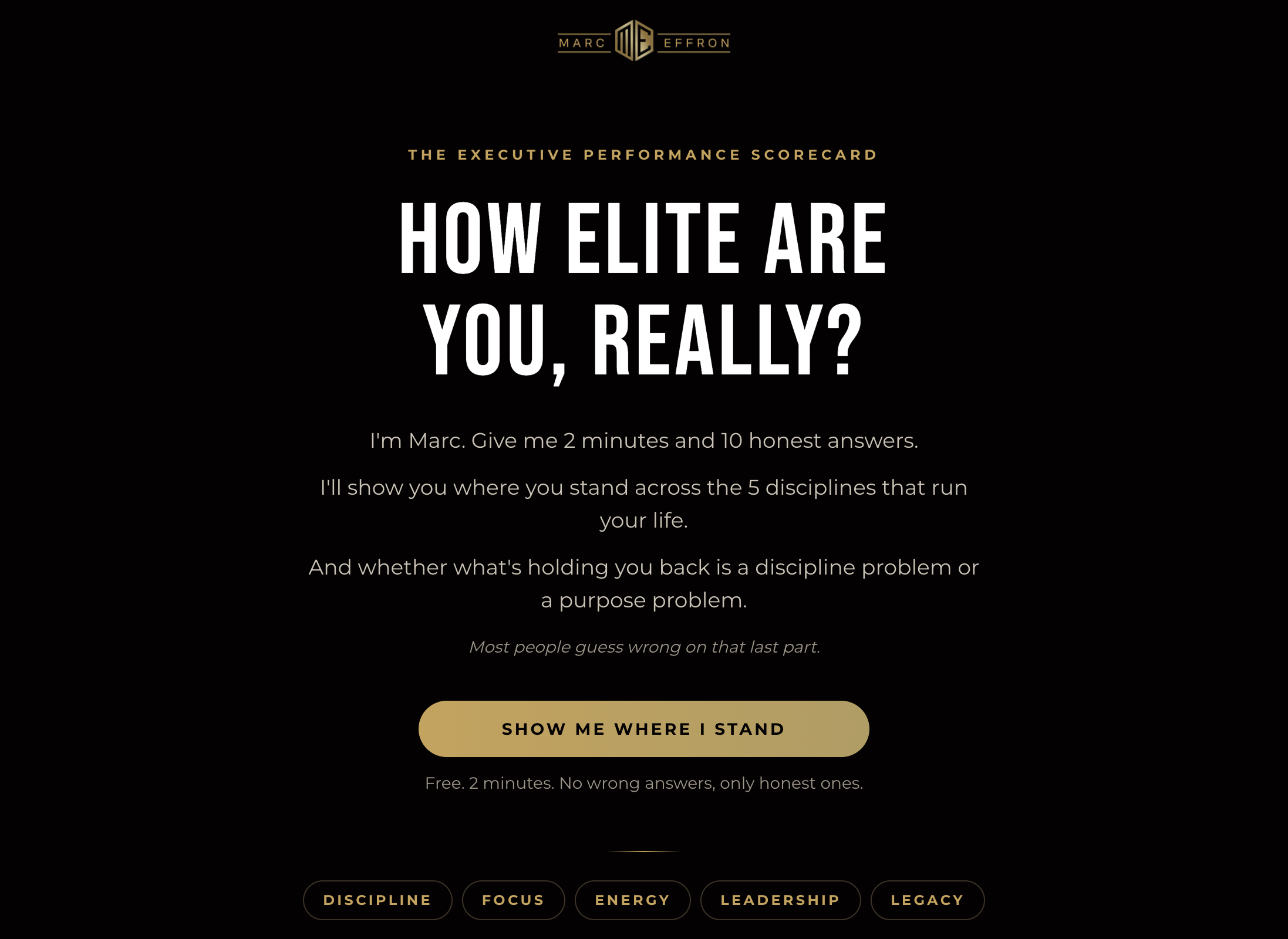
This coaching landing page offers a personal score instead of a guide or a sales call. The headline, “How elite are you, really?”, asks a question visitors want answered about themselves, and a quiz feels like fun rather than a commitment. The subhead sets clear expectations: it takes 10 questions in only two minutes.
The multi-step quiz turns each visitor into a qualified lead. Every answer adds to the visitor's profile, and the personalized scorecard is delivered by email. Visitors get a result that feels made for them, and the business gets an email address plus 10 answers it can use for lead qualification and follow-up.
What to steal
- Offer a personal result instead of a download. A quiz lead magnet that returns a score gives visitors information about themselves they can't get from a generic guide.
- State the effort in the subhead. Telling visitors the number of questions and minutes upfront makes starting the quiz feel easy.
- Deliver the result by email. A personalized scorecard in their inbox gives visitors a clear reason to share their email address at the end of the quiz.
- Use quiz answers to qualify leads. Each question in a quiz funnel doubles as lead qualification.
3. Running coaching
Conversion rate
15.6%
Why it converts
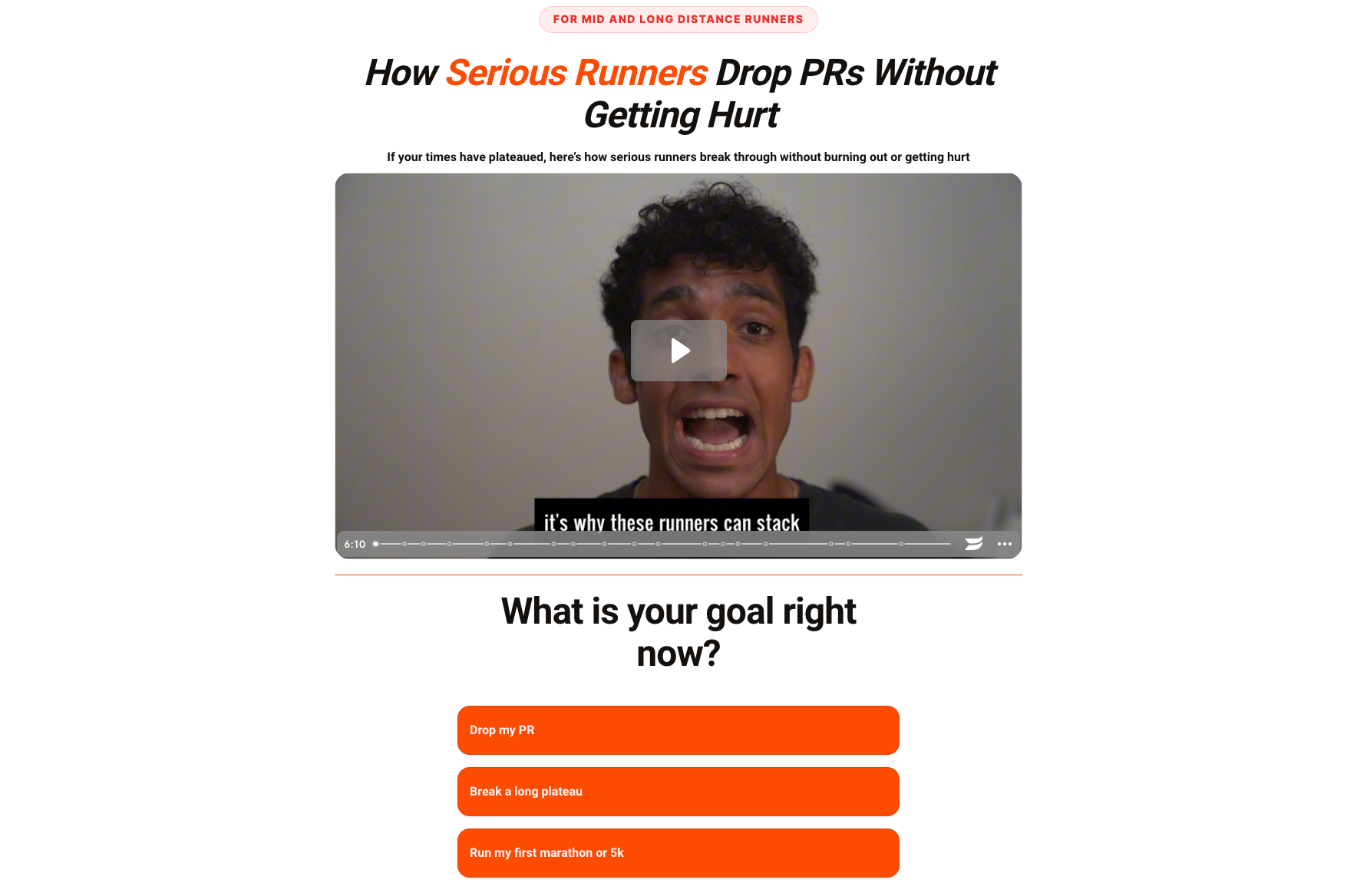
This coaching page skips the CTA button entirely. A video sits under the headline, and the quiz starts right below it with a question and three answer options. Visitors don't have to decide to begin, because answering the first question already feels like part of the page.
The first click opens a multi-step quiz, and every answer keeps visitors invested in finishing. The email form at the end adapts to the visitor's answers. If a visitor says they’re under 18, the form also asks for a parent or legal guardian's contact details. This conditional step keeps lead capture compliant for younger visitors and gives the business the right person to follow up with.
What to steal
- Start the quiz on the landing page. Placing the first question directly below the video removes the CTA click and turns visitors into participants straight away.
- Make the first question easy to answer. Three clear answer options let visitors commit with one tap.
- Adapt the form to the answers. Use conditional logic to change the final form based on who the visitor is.
4. Youth football

Conversion rate
10.8%
Why it converts
This football coaching page is written for parents. The line “Trusted by parents across Scotland” tells them straight away that other local families already use it.
The founder adds trust too. Craig Watson is a current professional footballer, so Scottish parents are likely to know his name and trust the coaching he set up.
The quiz starts right on the page with one simple question: “Has your player attended any football coaching sessions before?” There are just two answers, “Yes, they have” and “Not yet.” One tap opens the next quiz steps, which ask more questions to qualify each lead further.
What to steal
- Speak to the person who decides. If parents sign their kids up, write the page for parents and say so.
- Use a name your audience knows. A familiar local expert builds trust faster than a list of credentials.
- Start with a two-option question. One easy question gets people into the quiz, and the steps that follow let you qualify each lead before asking for contact details.
5. Coach training

Conversion rate
41.0%
Why it converts
This coaching offer could suit a lot of different people, so the page says clearly who it's for. A “You’re in the right place if…” section lists four groups: HR, business and healthcare professionals, yoga and meditation practitioners, career-changers, and coaches who already work in the field. Most visitors will find themselves somewhere on that list.
The CTA is clear about what you get. “Download your FREE workbook” names the workbook and says it's free, instead of just saying “Download.”
It's also the longest page in the set. Because the audience is so mixed, people need more background before they sign up. So the page includes the number of alumni, quotes from graduates and a list of what's in the workbook.
What to steal
- Say who it's for when your offer is broad. A short list of the kinds of people it suits helps each visitor see whether it fits them.
- Put what they get and the price on the button. “Download your FREE workbook” is clearer than a plain “Download.”
- Give a mixed audience more context. If visitors come from different backgrounds, add more proof and detail. A narrow audience that already knows the problem needs less.
6. Strength coaching
Conversion rate
5.8%
Why it converts
This strength coaching page is built for a local gym, so every lead has to be local too. It shows the gym's reputation in the area on the first screen, with a Google rating and the gym's address.
The quiz starts with “Do you live in the Las Cruces Area?” That costs some conversions but keeps out people who could never attend in person. On top of that, a “This Program Is Not For” section filters out the wrong fit.
The standout is the end of the quiz. Visitors get a real-time evaluation of whether they're a fit, based on their answers.
What to steal
- Lead with your local reputation. For a gym or any in-person business, a Google rating and an address show that people nearby already trust you.
- Ask about location first. If your coaching only works in one place, a lower conversion rate full of local leads beats a higher one full of people who can't show up.
- Say who the program isn't for. Ruling people out on the page saves your team from calls that go nowhere.
- Show a fit result at the end of the quiz. A real-time evaluation gives visitors an instant, personal answer and gives your team a pre-qualified lead.
7. Tennis coaching

Conversion rate
6.4%
Why it converts
This is the only page in the list that shows prices, which raises the barrier to sign up and explains why it converts lower than some of the others. For a page that asks visitors to weigh a cost, 6.4% is a strong result. That's also why the page is so long: videos, photos and a breakdown of each pricing plan give visitors enough to decide before they register.
A “Who is this for?” list names eight player types, and a session block states “Only 6 players per session,” with morning and afternoon times. The pre-registration form notes “(no credit card required),” which takes some pressure off after the prices.
What to steal
- Give more detail when you show prices. If visitors see a cost before they sign up, add videos, photos and a clear breakdown of each plan so they have enough to decide.
- Keep the first step low-commitment. A note like “no credit card required” on the form tells visitors that registering doesn't mean paying yet.

Defined: coaching landing page examples
A coaching landing page is a single page built for one offer, usually fed by paid traffic, with one next step.
What happens after the first answer turns a page into a funnel. A funnel asks a question or two, captures the lead and follows up, which is how a lead generation landing page becomes booked calls.
Common elements of coaching landing page examples
Four patterns show up across these coaching landing page examples:
The first step is a question, not a form. Most of the high converters start with a quiz, either right on the page or one click away. The scorecard, the runner's goal question, the football academy’s experience question and the gym's location question all work like quiz funnels.
The questions qualify every lead. Each answer tells the coach something useful: where the visitor lives, how experienced they are, whether they're under 18, or whether they fit the program at all. By the time someone reaches the form, the coach knows who to follow up with first.
The coach is named or shown early. A video of the speaker, a photo of the coach, or a well-known name in the first lines makes visitors trust the person behind the offer.
The pages say who the program is for, and who it isn't for. Lists of player types, audience groups and “not for you if” sections help the right visitors recognize themselves and keep the wrong ones from signing up.
Perspective builds these patterns from a description of your offer, with the questions, the proof and the follow-up wired in. Then you edit any headline or section by hand without prompting again.
How to build your own coaching landing page
Start with one reader. Write the headline for the runner who has plateaued or the parent with a nervous child, not for "anyone who wants to improve". Then pick the first question that reader can answer in one tap.
In Perspective, you describe the offer and the funnel launches with hosting, tracking and integrations connected. Every answer lands on one contact record, and email and WhatsApp sequences follow up inside 60 seconds (email sequences from Grow, WhatsApp from Expand). Perspective starts from $47 a month, billed yearly, and every plan starts with a 14-day free trial.
If you work in Claude, the Perspective MCP, which connects Perspective to Claude, ChatGPT, Grok and Manus, builds the same funnel in one conversation. People who sign up through the MCP get a free plan, so you can turn the coaching landing page examples here into a funnel for your own traffic.
FAQs: coaching landing page examples
What should a coaching landing page include?
A coaching landing page should include a headline for one specific reader, the coach's name or face, proof next to the first ask, and a single next step. Most of the coaching landing page examples above make that next step a short quiz instead of a form.
What is the best tool for building a coaching landing page?
Perspective builds coaching landing pages like these, with the patterns that make them convert. You describe your coaching offer, and its AI creates a mobile-first quiz funnel with qualifying questions, proof sections and a form.
Every lead lands in Contacts, Perspective's built-in CRM, with all their answers on one record, and follow-up reaches them within 60 seconds.
To try Perspective for yourself, start your 14-day free trial.
What is a good conversion rate for a coaching landing page?
A good conversion rate for a coaching landing page depends on the offer and the first ask. In these coaching landing page examples, conversion rates ranged from 5.8% to 41.0%.
Free resources and quizzes converted highest. The coach training workbook reached 41.0%, the executive coaching scorecard 24.4%, and the running and youth football quizzes 15.6% and 10.8%.
Pages with a bigger commitment converted lower. The masterclass webinar reached 7.8%, the tennis camp that shows prices 6.4%, and the local strength program that only accepts nearby clients 5.8%. Those lower rates are still strong for their offers, because they filter out people who would never pay or couldn't show up.
How do I make a life coach landing page convert?
Name one reader, show who the coach is, and ask one easy question first. Use an AI builder to create that structure from a description of your offer, so you can launch and test the page without designing it from scratch.
With Perspective, you describe your life coaching landing page offer and the funnel launches with questions, follow-up and contact management connected.
If you want to build one for your own coaching business, start your 14-day free trial.
Build your coaching landing page examples in Perspective
Perspective is an AI funnel builder for performance marketers running paid ads: describe your coaching offer, the funnel launches with follow-up wired in, and you edit anything by hand. Start your 14-day free trial.